Volunteer interest survey questions to ask as people sign up
A volunteer interest survey asks new sign-ups which jobs appeal, which hours they can give, what skills they bring and why they want to help, so each person gets a role that fits. Start with the 10-question form, then add sets for scheduling, first shifts, a yearly check-in and goodbyes.
- 38questions
- 10at sign-up
- 3 minto fill in
- 5add-on sets
By Michael Hodge, BSc Psychology Updated September 2026
From sign-up to goodbye: 38 volunteer survey questions
The sign-up form comes selected. Add the scheduling, first-shift, yearly or stepping-back sets when you need them. Under every question sit the answer choices a volunteer sees and a note for the coordinator on what to do with the result.
The sign-up form10 questions
Ten questions a new volunteer answers in about three minutes: how often and when, what kind of work, where, front line or behind the scenes, skills, the main reason for helping, how they found you, and how to reach them.
-
How often would you like to volunteer?
Every weekA few times a monthAbout once a monthFor one-off eventsNot sure yetSplits the weekly regulars your rota leans on from the event-day helpers. Plan for both: the typical volunteer now gives about 24 hours a year, so single events are where many people start.1
-
Which kinds of volunteer work interest you?
EventsChildren or teensFood and mealsOffice and adminFundraisingOutdoorsDrivingVisiting peopleTeaching or tutoringOnline tasksTick all that applyThe center of the form. Swap in your own role names, then count ticks per area: more ticks than places is a waiting list, and a role nobody ticks needs a better description.
-
When can you usually help?
WeekdaysWeekday eveningsSaturdaysSundaysIt variesTick all that applyHold these against your shift calendar before you phone anyone. A popular role at an hour nobody picked will stay empty however many people like it.
-
Where would you like to volunteer?
In personOnline or from homeA mix of bothNo preferenceVolunteers who served partly or fully online gave 95 hours a year on average, against 64 for in-person only, so a from-home role can add real time to your program.1
-
Which would you enjoy more?
Meeting the people we serveBehind-the-scenes tasksEither suits meFront-line roles and back-room roles suit different people. This answer sorts greeters and mentors from sorters, packers and spreadsheet fans before the first shift.
-
Which skills or experience could you bring?
TeachingCookingDrivingLanguagesFirst aidDesignSocial mediaBookkeepingComputersTick all that applySkilled roles are the hardest to fill from a general call. This list finds the bookkeeper, the designer and the second-language speaker already on your sign-up sheet.
-
What is the main reason you want to volunteer?
A cause I care aboutTo learn new thingsTo meet peopleExperience for work or studyTo feel usefulA change from routineOne option for each of the six motives in the Volunteer Functions Inventory. Roles and messages that match the main one lead to more satisfied volunteers who plan to stay.2
-
How did you hear about volunteering with us?
A friend or relativeSocial mediaOur websiteA flyer or stallSomewhere elseYour recruitment scorecard. After a season, set the counts beside who is still coming and you know which channel to spend your next hour on.
-
Is there anything we should know to make volunteering work for you?
Open answerAccess needs, a school run at three, an allergy, a bad back. Asked openly, people mention the detail that makes or breaks a placement.
-
Your name and the best email or phone number to reach you
Open answerAsked last, after people have said what they want to do, it reads as the next step toward a role instead of a gate at the door.
Scheduling details5 questions
For coordinators who run a weekly rota: who people want to work beside, when they can start, how much notice they need and who can cover a gap.
-
Who would you like to volunteer with?
A teamOn my ownA friend or family memberAny of thesePeople who sign up as a pair expect to be scheduled together. Knowing it up front saves a no-show when the rota splits them.
-
How soon could you start?
This weekWithin a monthIn a few monthsJust exploring for nowSets the order of your calls. Ready-this-week people get a role offer first, while the explorers get an invitation to an open day.
-
How much notice do you need before a shift?
A day or lessTwo or three daysA weekTwo weeks or moreSorts the people who can fill a gap tomorrow from those who need the rota a fortnight ahead.
-
Could we call you when a shift needs last-minute cover?
YesSometimesNoBuilds an on-call list without asking regulars to promise more than they want to give.
-
Do you hold a current background check for work with children or vulnerable adults?
YesNoNot sureRoles with children or vulnerable adults usually require one. Anyone who already holds a check can start in those roles sooner.
After a first shift5 questions
Send these within a few days of someone's first shift, while the details are fresh. Early problems are cheap to fix and expensive to ignore.
-
On my first shift I knew where to go and who to ask.
Strongly disagree12345Strongly agree1 = Strongly disagree, 5 = Strongly agreeThe welcome test. A low score points at the arrival routine, not at the volunteer.
-
The task I did matched what I signed up for.
Strongly disagree12345Strongly agree1 = Strongly disagree, 5 = Strongly agreeChecks the promise made on the sign-up form. Mismatches here are the first sign of a quiet exit.
-
Someone on the team made me feel welcome.
Strongly disagree12345Strongly agree1 = Strongly disagree, 5 = Strongly agreeNames the human side of the first day. Pair a low score with a buddy for the next shift.
-
Will you sign up for another shift?
Yes, soonYes, later onNot sureNoEvery "not sure" is worth a phone call this week. The answer usually arrives in the first minute of it.
-
What would have made your first shift easier?
Open answerProduces the fixes for your next orientation: a map, a name badge, a start-time text, a clearer brief.
Once a year for regular volunteers12 questions
For people who have volunteered with you for a few months or more. The first three statements cover the two things most closely tied to volunteers staying: seeing the difference they make and feeling part of the group.
-
How long have you volunteered with us?
Under 6 months6 to 12 months1 to 3 yearsMore than 3 yearsSplit the results by it to see whether newer volunteers and the old hands rate training and schedules differently.
-
I can see the difference my volunteering makes.
Strongly disagree12345Strongly agree1 = Strongly disagree, 5 = Strongly agreeParticipation efficacy, one of the two satisfaction dimensions that predicted intent to remain in the Volunteer Satisfaction Index study.4
-
My role makes good use of my skills.
Strongly disagree12345Strongly agree1 = Strongly disagree, 5 = Strongly agreeThe second half of feeling effective. Low scores flag people ready for a bigger or different role.
-
I feel connected to the other volunteers.
Strongly disagree12345Strongly agree1 = Strongly disagree, 5 = Strongly agreeGroup integration, the other dimension that predicted staying. Team shifts and a volunteer social move it.4
-
I get the training I need for my role.
Strongly disagree12345Strongly agree1 = Strongly disagree, 5 = Strongly agreeTraining is one of the practices tied to higher retention across more than a thousand charities.3
-
I hear about schedule changes in good time.
Strongly disagree12345Strongly agree1 = Strongly disagree, 5 = Strongly agreeThe rota question. Late changes are a common, fixable reason regulars drift away.
-
Staff treat volunteers as part of the team.
Strongly disagree12345Strongly agree1 = Strongly disagree, 5 = Strongly agreeShows whether paid staff and volunteers work as one crew or two. Read it by site or program if you have several.
-
When I suggest an idea, someone follows up.
Strongly disagree12345Strongly agree1 = Strongly disagree, 5 = Strongly agreeAsks about follow-through rather than whether people feel heard in general. A low score with a full suggestion box means nobody replies.
-
I feel thanked for what I do.
Strongly disagree12345Strongly agree1 = Strongly disagree, 5 = Strongly agreeRecognition, the other retention practice in the charity study. A handwritten note often moves it more than an annual dinner.3
-
Do you expect to be volunteering with us a year from now?
Yes, definitelyProbablyNot sureProbably notYour early warning for next year's gaps. Read the open answer from everyone who picks "not sure" or "probably not".
-
How likely are you to recommend volunteering here to a friend?
0123456789100 = Not at all likely, 10 = Extremely likelyA single 0 to 10 number to track year on year. Charities whose volunteers recruit others one-on-one also keep more of them, so ask your high scorers to bring a friend.3
-
What is one change that would make volunteering here better?
Open answerOne change, not a wish list. The answers cluster into three or four themes you can act on before next year.
When someone steps back3 questions
A short, friendly note for volunteers who stop or pause. The answers tell you which departures were preventable.
-
What is the main reason you are stepping back?
Less free timeMoving awayHealth or familyThe role did not suit meI did not feel valuedSomething elseTime and moves are life; role fit and feeling valued are yours to fix. Count the last two separately.
-
Would you help at a one-off event in future?
YesMaybeNoKeeps the door open. Many people who leave a weekly rota still say yes to a single day.
-
What would have kept you volunteering with us?
Open answerThe most direct answer you will get about your program. Read these before you plan next year's recruitment.
About you (optional)3 questions
Useful only if you plan to split results, for instance students against retirees. Report only on groups with enough volunteers in them that no answer can be traced.
-
What is your age group?
Under 1818 to 2425 to 4445 to 6465 or olderUnder-18s usually need a parent or guardian consent form, so this also flags the paperwork.
-
Which best describes you right now?
WorkingStudyingRetiredSomething elsePredicts which hours people can give better than age does. Students need term dates; retirees often want weekday mornings.
-
Have you volunteered before?
Yes, with usYes, elsewhereNo, this is my first timeFirst-timers need a fuller orientation. Returners and experienced volunteers can often start on a normal shift.
From a completed form to a role offer
Read every form in three passes: when (times and how often), what (kinds of work, skills, setting) and why (the main reason). Then offer the one role that fits all three.
| What the form says | Role to offer | Why it fits |
|---|---|---|
| Weekdays, food, front line | Tuesday pantry shift | Right hours, face to face |
| Saturdays, outdoors, a team | Park cleanup crew | Weekend slot, group work |
| Online, social media, career | Social posts from home | Uses a skill, builds a portfolio |
| One-off events, meet people | Festival steward with a buddy | Short and sociable |
| Driving, weekdays | Meal delivery route | Skill and time in one role |
Across a batch of forms, set the tick counts for each kind of work beside the places you have open. Charities that screen volunteers and match them to suitable jobs keep more of them,3 so this sorting is worth an hour a week. More audience research surveys sit in the marketing survey questions category.
A volunteer drive built around the form
Where you put the form, how fast you answer it and when you ask again matter as much as the questions.

Put the form where people already say yes
Most offers of help happen in a moment: at a fundraiser, after a talk, at the end of a service or a game. Stand a table card with a scannable code for the form by the door, keep paper copies on a clipboard beside it, and add the link to every thank-you email. Interest is on the rise: 28.3% of Americans aged 16 and over volunteered through an organization in the year to September 2023, up from 23.2% in 2021.1
Average hours given per volunteer in a year
Offer at least one role people can do from home
Almost one in five formal volunteers now serves partly or fully online, and those volunteers give more time: 95 hours a year on average, compared with 64 for people who only volunteer in person.1 A newsletter, phone calls, social posts or data entry can all run from a kitchen table. Question 4 finds the people who want them.

Reply the same week with one named role
A form that vanishes into an inbox teaches people not to bother. Sort the week's forms with the matching table above, then phone or email each person with one specific role, a date and a contact name. Screening and matching volunteers to suitable jobs, training them and recognizing their work are the practices linked to higher retention in a survey of 1,354 charities.3
Ask again after the first shift and every year
The first-shift set catches problems while they are small. The yearly set leads with the two things that predicted whether volunteers intended to stay in the Volunteer Satisfaction Index study: feeling that their work makes a difference, and feeling part of the group.4 Share what you learned at the next volunteer meeting and name one thing that will be different next month.
Hosting a volunteer info night? Warm the room up with one question everyone can answer from their seat, sent to their phones as a quick poll with live results. The bars double as a check on which recruitment channel is working. Our page on how to make a poll lists other ways to share one.
Six reasons people volunteer, and what to offer each
The Volunteer Functions Inventory, developed by Clary and colleagues, sorts the reasons people give their time into six motives. Question 7 asks for the main one in everyday words.
| Answer on the form | Motive | What to offer |
|---|---|---|
| A cause I care about | Values | Impact news: people served, a story from each shift |
| To learn new things | Understanding | Training, rotating tasks, a behind-the-scenes tour |
| To meet people | Social | Team shifts, a buddy, a seasonal social |
| Experience for work or study | Career | A skills role, logged hours, a reference |
| To feel useful | Enhancement | A named job and thanks that says what they did |
| A change from routine | Protective | A regular slot with the same friendly crew |
Matching pays twice. In the original studies, recruitment messages aimed at a person's main motive persuaded more than mismatched ones, and volunteers whose experience fit their motives were more satisfied and more likely to keep volunteering.2 Use the answer in your welcome message and again when you offer a second role.
A minute at the festival stall
At a fair, a festival stall or the back of a meeting you get a minute, not four. These five capture what people want to do, when, how often, what they can bring and how to reach them.
- 01Which kinds of volunteer work interest you?
- 02When can you usually help?
- 03How often would you like to volunteer?
- 04Which skills or experience could you bring?
- 05Your name and the best email or phone number to reach you
A clipboard for outdoor events
At an outdoor event a clipboard often beats a code on a card: no signal needed, no phone to dig out. Print a stack, clip them to a board with a pen on a string, and type them up the same evening.
Recruiting at one event? and clip a stack to the board.
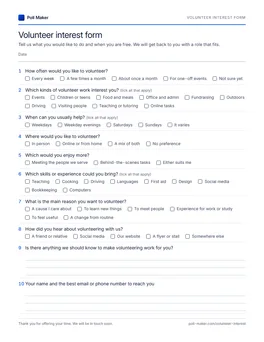
Volunteer interest form
Page one is the 10-question sign-up form with space for a name and a phone number or email. Later pages hold the optional sets: scheduling, first shift, yearly check, stepping back and a few details about the volunteer.
Download PDFVolunteer form questions to rewrite
Each of these turns up on real sign-up forms, and each better version gives you something you can put on a rota. For rewrites of every other kind of question, open the survey question guide.
Are you available to volunteer?
When can you usually help? (weekdays, weekday evenings, Saturdays, Sundays)
Everyone who fills in the form says yes. The better version gives you slots you can match to shifts.
What skills do you have?
Which skills or experience could you bring? (a tick list, plus space for anything else)
A blank box collects "people skills". A list jogs memories of the clean driving record, the first aid course and the second language.
How satisfied are you with our volunteer program and staff?
I can see the difference my volunteering makes.
Staff treat volunteers as part of the team.
Program and staff squeezed into one question: a low answer leaves you guessing which of them needs the work.
Would you be willing to help with anything we need?
Which kinds of volunteer work interest you?
"Anything" earns a polite yes and a person you cannot place. Specific kinds of work tell you where they will be happiest.
What volunteer coordinators ask
Answers to the questions that come up when a sign-up form is being set up.
What should a volunteer interest form ask?
When the person is free and how often, which kinds of work interest them, where they want to help, the skills they bring, the main reason they want to volunteer, how they heard about you, and how to reach them. That is the 10-question sign-up form on this page, and it takes about three minutes.
What are the six motivations for volunteering?
Values, understanding, social, career, enhancement and protective. They come from the Volunteer Functions Inventory by Clary and colleagues (1998). The motive table above shows what to offer a volunteer whose main reason falls under each one.
How do you measure volunteer satisfaction?
Run the yearly set once a year with your regular volunteers. For every statement, count the volunteers who picked 4 or 5 and turn that into a percent of all replies. Rank the statements by that percent and start work on the bottom two. The recommend-to-a-friend score, from 0 to 10, gives you one number to follow from year to year.
Should a volunteer survey be anonymous?
The sign-up form cannot be, because you need to contact people. The yearly and stepping-back sets work best without names: send them as a separate survey, tell people who sees the replies, and keep every group you report on big enough that no single volunteer stands out.
Is there a volunteer interest form template I can edit?
Yes. The builder button opens the sign-up form with every question and answer option loaded, ready to rename roles and add your logo. You can also copy the questions into another tool, or build your own from scratch in the free form builder.
Sign up your next volunteers this week
Email the sign-up form to your supporters today, and clip a few paper copies to a board for the next fair or open day.