A sustainability survey on last week's travel, food and home energy
A useful sustainability survey asks what people actually did last week: how they travelled, what they ate, how often they flew and how they run their home. The core 12 covers those choices in about four minutes. Staff, student and customer sets sit underneath for when you need them.
- 36questions
- 12in the core
- 4 minfor the core
- Staffstudents or public
By Michael Hodge, BSc Psychology Updated September 2026
All 36 sustainability questions, with answer choices
Everyday choices are pre-selected. Tick the work set for staff, the school set for students, the shopping set for customers or the views set for an awareness study. Under every item you get its answer options and what a big or small count would tell you.
Everyday choices core12 questions
Six questions on the choices that move a footprint most, each tied to a recent week, month or year. After them come five agree statements that feed the results chart, and an open question on what would help.
-
How did you make most of your trips last week?
Car, aloneCar, sharedBus or trainWalk or bikeStayed homeOf the choices in the core, the car carries the largest saving: living car-free saves about 2.4 tonnes of CO2e a year. Weigh this answer above the rest.1
-
How many return flights did you take in the past 12 months?
None12 to 34 or moreOne return transatlantic flight adds about 1.6 tonnes, more than a year of most household habits. A few frequent flyers can carry a group total.1
-
On how many days last week did you eat meat?
None1 to 23 to 45 to 6Every dayDays are easier to recall than a diet label. A plant-based diet saves about 0.8 tonnes a year, so the spread shows how much room there is.1
-
Which of these did you do at home in the past month?
Washed laundry coldAir-dried laundryTurned the heating downSwitched devices offNone of theseTick all that applySmall, frequent energy habits. Cold washing and air drying save about a quarter of a tonne each a year, so read them as a group.1
-
Does your home get its electricity from a renewable source?
Yes, a green tariffYes, solar panelsNoNot sureDepending on the local grid, green power saves anything from under 0.1 to 2.5 tonnes a year. Many "Not sure" answers point to an information gap.1
-
Which of these do you sort out of your rubbish at home?
Paper and cardPlastics and cansGlassFood scrapsNone of theseTick all that applyA habit many people already have. Thorough recycling saves about a quarter as much as a plant-based diet, so read it next to the travel and food answers.1
-
I know which of my daily choices do most to cut my footprint.
Strongly disagree12345Strongly agree1 = Strongly disagree, 5 = Strongly agreeCompare it with the travel and food answers. Agreeing while driving alone every day shows who needs to see what makes the biggest difference.
-
I can usually afford the greener option.
Strongly disagree12345Strongly agree1 = Strongly disagree, 5 = Strongly agreeWhen cost is what holds people back, the answer is an offer or a subsidy, not another information campaign.
-
I know where to find advice I trust on greener choices.
Strongly disagree12345Strongly agree1 = Strongly disagree, 5 = Strongly agreePeople who cannot tell good advice from marketing tend to wait. A low score calls for one clear, named source.
-
Most people around me make green choices too.
Strongly disagree12345Strongly agree1 = Strongly disagree, 5 = Strongly agreeA low score is a reason to share your results with the group, so people see how many of their colleagues or classmates already act.
-
I plan to change one thing to cut my footprint in the next three months.
Strongly disagree12345Strongly agree1 = Strongly disagree, 5 = Strongly agreePlans run well ahead of action, so treat this as the ceiling. Ask again in three months and compare with the behaviour questions.4
-
What would make it easiest for you to live more sustainably?
Open answerAnswers name the barrier in the respondent's own words: a bus route, a bike rack, a cheaper option. Group them into three or four themes.
At work (employees answer)7 questions
For an employee sustainability survey run by a green team, HR or facilities. Employees fill in the core for themselves, then rate the workplace here.
-
How do you usually get to work?
Drive aloneCarpoolBus or trainWalk or bikeWork from homeThe commute is a footprint an employer can shape directly. Split it by site before planning parking, shuttles or bike storage.
-
I know what my employer is doing to reduce its environmental impact.
Strongly disagree12345Strongly agree1 = Strongly disagree, 5 = Strongly agreeAwareness of the program itself. A low score means the work is happening but nobody has heard about it.
-
My employer backs its sustainability goals with real action.
Strongly disagree12345Strongly agree1 = Strongly disagree, 5 = Strongly agreeStaff notice when targets have no budget behind them. A gap between this and the awareness question signals doubt about the program.
-
It is easy to avoid waste at my workplace.
Strongly disagree12345Strongly agree1 = Strongly disagree, 5 = Strongly agreeBins, refill points and double-sided printing are cheap fixes. Low scores by site show where to start.
-
How much say do employees have in the company's sustainability plans?
A lotSomeA littleNoneNot sureAsks whether staff feel involved at all. Many "Not sure" answers suggest the green team is invisible to most people.
-
Which of these would you join?
Green teamCycle to work schemeCarpool matchingRepair or swap dayVolunteer dayNoneTick all that applySizes each idea before anyone books a room or buys racks. Launch the one with the most names first.
-
What is one change our workplace should make first to be more sustainable?
Open answerStaff see waste leaders miss: lights left on in empty rooms, the idling delivery van, the printer nobody needs.
At school or college (students answer)5 questions
For sustainability questions to ask students, an eco club or a campus green audit. Students cover their own week in the core, then judge the school here.
-
My classes have shown me how my choices affect the environment.
Strongly disagree12345Strongly agree1 = Strongly disagree, 5 = Strongly agreeTests whether lessons connect to daily life. Compare year groups to see where it drops off.
-
My school acts on its green goals, not only talks about them.
Strongly disagree12345Strongly agree1 = Strongly disagree, 5 = Strongly agreeStudents spot the gap between an eco poster and an overflowing bin. A low score is worth hearing before an inspection does.
-
How often does sustainability come up in your lessons?
NeverRarelySometimesOftenAlwaysShows how widely the topic reaches beyond science and geography. Read it by subject if you can.
-
Which of these would you take part in at school?
Eco clubClean-up daySchool gardenSwap shopClimate projectNoneTick all that applyNames the projects with enough volunteers to run. Start with the top two.
-
If you could start one green project at your school, what would it be?
Open answerStudents often suggest ideas staff would never think of, and they will help run the ones they suggested.
Shopping and products (customers answer)5 questions
For brands, shops and marketing students measuring green buying, packaging choices and trust in eco claims.
-
How often do you check how sustainable a product is before you buy it?
NeverRarelySometimesOftenAlwaysBehaviour at the shelf, not a stated value. Compare it with the price question to see how much the check really weighs.
-
Would you pay more for a product with a lower environmental impact?
NoUp to 5% more5% to 10% moreOver 10% moreDepends on the productBands give a usable number. Treat it as an upper limit, because stated green intentions run well ahead of purchases.4
-
What stops you buying greener products more often?
PriceHard to findNot sure what to trustLower qualityHabitNothingTick all that applyEach barrier has a different fix: price, stock, labelling or product quality.
-
I can tell a genuine green claim from marketing.
Strongly disagree12345Strongly agree1 = Strongly disagree, 5 = Strongly agreeLow confidence means a certification or plain proof on the label will do more than another slogan.
-
If the price were the same, which packaging would you choose?
RecyclableRefillableCompostableLeast packagingNo preferenceA like-for-like choice for a sustainable packaging questionnaire. It removes price so you see the preference itself.
Views on climate and nature4 questions
For awareness surveys, community groups and research projects that need attitudes next to behaviour.
-
How worried are you about climate change?
Very worriedSomewhat worriedNot very worriedNot at all worriedConcern and action often differ, so its value is in comparing groups and tracking change from one year to the next.
-
Who should do the most to cut emissions?
GovernmentsBusinessesIndividualsAll equallyNot sureShows where people place responsibility, which shapes whether they back a workplace or campus program.
-
What I do day to day makes a real difference to the environment.
Strongly disagree12345Strongly agree1 = Strongly disagree, 5 = Strongly agreePair it with the plans statement in the core to see whether low plans come with a feeling that nothing helps.
-
How often do you talk about the environment with friends or family?
NeverRarelySometimesOftenAlwaysA group that rarely talks about it may respond well to a shared challenge or a class discussion.
About you (optional)3 questions
Ask these only if you plan to compare groups, and never show results for a group so small that someone could be recognised.
-
How old are you?
Under 1818 to 2425 to 4445 to 6465 or overTravel, flying and diet can differ with age. Compare age groups only when each has enough answers.
-
Which best describes where you live?
CitySuburb or townRural areaRural respondents may have no bus to take. Read the travel answers by area before judging them.
-
Are you currently working, studying or both?
WorkingStudyingBothNeitherTells you who should also get the work set or the school set when one link goes to everyone.
Rank the habits by the emissions they save
Counting green habits treats a reusable bag like a year without a car. Use the savings measured by Wynes and Nicholas to rank what your group already does and where the big wins are.1
| Core answer | Saving it points to | How to read the count |
|---|---|---|
| Walk, bike, bus or train, or stayed home (question 1) | Up to 2.4 t a year | Share of people already travelling low carbon |
| Each return flight (question 2) | About 1.6 t per flight | Add up flights to find the group total |
| Meat on two days or fewer (question 3) | Up to 0.8 t a year | Share eating mostly plant-based |
| Cold wash and air dry (question 4) | About 0.46 t a year together | Small, but easy to spread |
| Sorting rubbish (question 6) | About a quarter of the diet saving | Usually already high |
A worked example
Suppose 60 staff answer. Twelve people report 30 return flights between them: 30 x 1.6 = 48 tonnes. Forty-two people drive to work alone. Fifty-one already sort paper, plastics and glass. The recycling rate looks like the success story, but the flights and the solo car trips hold far more of the footprint. A travel policy and a carpool scheme are the first two changes to put in front of the group, and the open answers to question 12 tell you what would make them work.
These figures are averages for developed countries and describe whole actions, such as a year without a car. Use them to rank choices against each other, not to estimate one person's footprint.
Pulling answers back toward real behaviour
Everyone wants to look green on a survey. These four design habits pull the answers back toward real behaviour.
Emissions saved by one person's action (tonnes CO2e)
Spend your questions on the big choices
Most green surveys ask about recycling, light bulbs and reusable bags. Those habits matter, but a review of 39 sources found that living car-free, flying less and eating a plant-based diet each save far more.1 Skipping a single return flight across the Atlantic saves about 1.6 tonnes of CO2e, while thorough recycling for a whole year saves about a quarter of what a plant-based diet does.1 The core gives travel, flights and food a question each for that reason.

Ask about last week, not about "usually"
Across 15 studies of 6,260 people, what respondents said about their green habits matched measured behaviour only in part: the correlation was .46, which leaves 79% of the variation unexplained.2 A short, recent window helps. "On how many days last week did you eat meat?" is easier to answer honestly than "Do you eat a sustainable diet?", because the respondent counts instead of judging themselves.

Keep plans and actions apart
Harvard Business Review reports that 65% of consumers say they want to buy from purpose-driven brands that advocate sustainability, yet only about 26% actually do.4 So the core asks what people did and, separately, what they plan to do. Report the two side by side. Never add them together into a single green score.
Check a few answers against a count
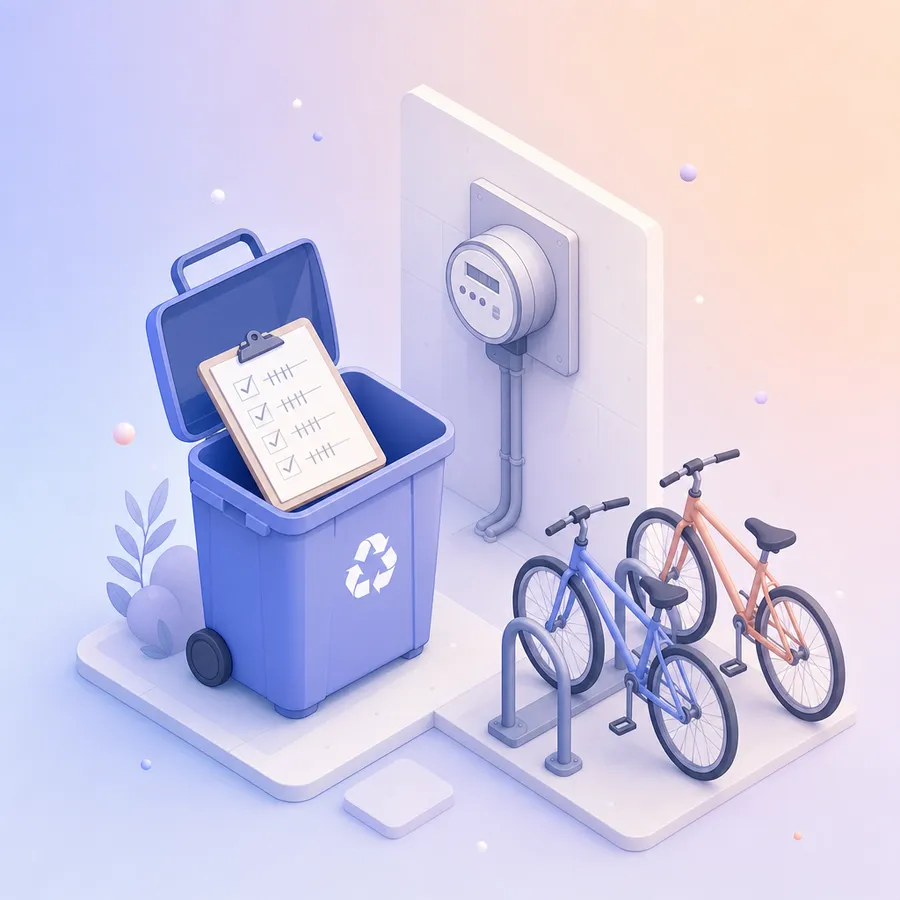
The self-report review suggests adding an objective measure wherever you can, such as a meter reading or a trained look inside the bins.2 A week of bike rack counts, a bin audit or last quarter's energy bill turns a survey into a baseline. Worry about people giving the answer they think you want is common, but three meta-analyses found only small links between that tendency and green self-reports (pooled correlations of 0.06 to 0.11).3 An anonymous link and a neutral intro are enough for most groups.
Starting a staff meeting, a class or a climate event? Show one question as a live phone poll and have everyone vote before you speak. Who should cut emissions first splits most rooms straight away. First time? The poll setup walkthrough gets one live in a couple of minutes.
Turn the five statements into a results chart
For each of the five core statements, enter the count of respondents at every point on the scale. Agreement always means readiness to act, and the lowest bar names the barrier to tackle first: knowledge, cost, trusted advice, what others do, or a plan.
- 1A statement's score is the share of its respondents choosing 4 or 5. The chart updates while you enter the counts.
- 2Look for the lowest bar. Cost calls for offers or subsidies, trust for one clear source, and knowledge for a short talk on the big three: travel, flights and food.
- 3Set the plans statement next to the travel and meat answers. High plans with little change means people need help, not persuasion.
- 4Sort the open answers into a few piles. Then show people the chart and name a single change you will make easier.
Readiness to act
Staff, students or shoppers: picking the set
The core works for anyone. The sets that follow it depend on who you send it to and what you want to decide.
| You are surveying | Add to the core | What you can decide |
|---|---|---|
| Staff at one employer | At work, then About you | Commute schemes, office waste fixes, what the green team runs first |
| Students in a school or college | At school or college | Eco club projects, where lessons can link to daily life |
| Customers of a shop or brand | Shopping and products | Packaging, price premiums, what proof to put on labels |
| Residents or a research sample | Views on climate and nature, About you | How attitudes and habits differ by age and area |
Running a wider staff survey at the same time? Keep it short by sending this core as its own link, and find more workplace topics among the employee survey questions. For other surveys on how a company runs, browse the business survey questions.
The big footprint choices in five questions
Only have a minute of people's time? Travel, flights and meat carry most of the footprint, one statement checks what people know, and the open question tells you what to make easier.
- 01How did you make most of your trips last week?
- 02How many return flights did you take in the past 12 months?
- 03On how many days last week did you eat meat?
- 04I know which of my daily choices do most to cut my footprint.
- 05What would make it easiest for you to live more sustainably?
Paper for briefings, assemblies and fair stalls
Paper suits a staff briefing, a school assembly or a stall at a community fair: people tick the boxes there and then and drop the sheet in a box. Both files fit US letter and A4.
At a fair stall, page one alone makes a sheet people can finish standing up.
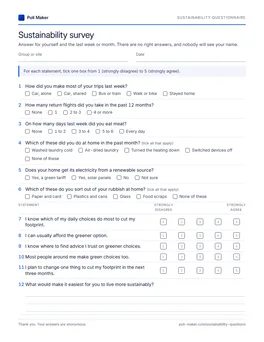
Sustainability questionnaire
Page one prints the everyday choices core ready for a pen. Later pages hold the work, school, shopping, views and About you sets.
Download PDF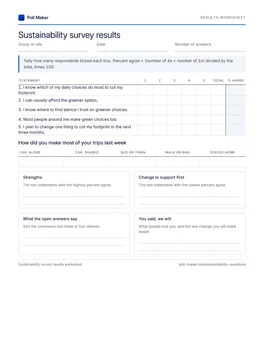
Results worksheet
One sheet for hand tallies: the five statements and the trips question, a percent agreeing box for each, and a space to mark which change to back first.
Download PDFA questionnaire on environmental sustainability for a thesis
Students searching for a questionnaire on environmental sustainability usually need a research question and a plan for the analysis as well as the items.
Research questions this set can answer
Do people who say they know which choices matter most (question 7) travel and eat differently from those who do not? Is the gap between plans (question 11) and meat days (question 3) wider for younger respondents? Do rural and city respondents differ on the car question once you allow for bus access? All three can be answered with the core plus the About you set.
Adding a published attitude scale
If the brief calls for a validated attitude measure, the usual choice is the revised New Ecological Paradigm scale, 15 statements about how people see the balance between humans and nature.5 Take its items word for word from the published paper and cite it. The views set here is our own wording and is not a version of that scale.
Before you send it
Say in the first line who is running the survey and why, keep it anonymous, and ask your teacher or ethics committee to approve the final list. Pilot it with five friends and time them. Adding the waste topic? The household waste questionnaire is written for the same kind of project.
Green survey questions that invite a flattering answer
These weak versions appear on green surveys all the time. The same repairs work across the survey question library.
Do you care about the environment?
On how many days last week did you eat meat?
Almost everyone says yes to caring, so the answer tells you nothing. A count of recent behaviour shows real differences between people.
Do you recycle and save energy at home?
Which of these do you sort out of your rubbish at home?
Which of these did you do at home in the past month?
Two topics in one question. Someone who recycles but leaves the heating high cannot answer it honestly.
How sustainable is your lifestyle?
How did you make most of your trips last week?
People rate themselves against their friends, not a standard. Ask about the choice itself.
Would you buy eco-friendly products if they cost more?
Would you pay more for a product with a lower environmental impact? (answered in price bands)
A yes or no invites the socially easy yes. Bands such as up to a twentieth more give a number to plan with.
What green teams and teachers want to know
For green teams, teachers, marketers and students.
What questions should a sustainability survey include?
Start with the choices that matter most: how people travel, how often they fly, how often they eat meat and how they power their home. Add a few statements on knowledge, cost and plans, one open question on what would help, and then the set for your group: staff, students or customers.
How do you run an employee sustainability survey?
Send the core plus the At work set as an anonymous link, and give people a week. Report results by site or team only where a group is big enough to stay anonymous. Share the results within a month, together with the first change you will make, and repeat the survey a year later to see what moved.
What sustainability questions can I ask students?
Use the core about their own week and add the school set. For younger students, read the questions aloud and replace the five-point scale with yes, sometimes and no. The travel and meat questions work at any age.
Is this the same as an ESG questionnaire?
No. An ESG questionnaire is filled in by a company about its policies, emissions and governance, often for investors or large customers. This survey asks people about their own habits and views. Plenty of firms do both: the ESG return for investors, and a people survey such as this for planning programs.
How many questions should a sustainability survey have?
For most groups the core 12 is plenty, at roughly four minutes. Pick one extra set only when it serves a decision. All 36 take around ten minutes, which suits a research study better than a staff pulse.
Find out which green changes your group will make
Open the everyday choices core in the builder, bolt on the staff, student or customer set, and have the link out this week. Printed copies suit briefings and classrooms.