Screen time questionnaire for students at school and adults at work
A screen time survey asks how many hours people spend on screens outside school or work, on which devices, and whether they feel in control of it. The core 12 does all three in about four minutes, and its hour bands line up with national teen figures.
- 36questions
- 12in the core
- 4 minto answer the core
- Age 13and up
By Michael Hodge, BSc Psychology Updated September 2026
36 questions on hours, devices, sleep and eyes
The core 12 comes ticked. Under every question you will find its answer options and a note on what the answer reveals. Switch on the students or adults set, add evenings or cutting back, and send your version as a link, a paper sheet or pasted text.
The core 1212 questions
Hours on a school or work day and on a day off, the screens and uses behind them, the figure the phone logged, five statements about control, and where people want to go next.
-
On a school or work day, how many hours are you on screens for fun?
Under 2 hours2 to 3 hours4 to 5 hours6 to 7 hours8 hours or moreLeisure hours only (not school or work screens), the way national surveys ask. The 2 and 4 hour lines both fall on a band edge, so you can compare with guidelines and published figures.1
-
On a day off, how many hours are you on screens?
Under 2 hours2 to 3 hours4 to 5 hours6 to 7 hours8 hours or moreDays off usually look different, and a single "typical day" answer blurs the two. Asking both gives you a weekly average.2
-
Which screens did you use yesterday?
PhoneTabletComputerTVGames consoleSmartwatchTick all that applyShows where the hours live. A group that is mostly phone needs different advice from one that is mostly TV and console.
-
Outside school or work, what do you mostly use screens for?
VideosSocial appsGamingMessagingMusicReadingBrowsingTick all that applyTwo people with the same hours can have very different days. This splits watching, playing and talking.
-
What was yesterday's total in your phone's screen time report?
Open answerA logged number to set beside the guess in question 1. The gap between them is often the most interesting result.3
-
I am happy with the amount of time I spend on screens.
Strongly disagree12345Strongly agree1 = Strongly disagree, 5 = Strongly agreeSatisfaction, not hours. Someone on screens for six hours who is happy with it needs a different conversation from someone on three who is not.
-
I can put my phone down when I need to focus.
Strongly disagree12345Strongly agree1 = Strongly disagree, 5 = Strongly agreeControl in one sentence. A low score here matters more than a high hour count.
-
My phone is out of reach when I go to sleep.
Strongly disagree12345Strongly agree1 = Strongly disagree, 5 = Strongly agreeThe single bedtime habit most worth tracking. The evenings module goes further.4
-
Screens rarely push out things I had planned to do.
Strongly disagree12345Strongly agree1 = Strongly disagree, 5 = Strongly agreeAsks about the trade people notice: the walk, the chapter or the chore that did not happen.
-
Most days I get outside or move about.
Strongly disagree12345Strongly agree1 = Strongly disagree, 5 = Strongly agreeShows whether screen time sits beside an active day or replaces it.
-
Would you like to change how much time you spend on screens?
Cut it a lotCut it a littleKeep it as it isSpend moreReadiness to change. It tells you how many people will welcome a challenge week and how many will shrug.
-
What would you like to do with some of the time you now spend on screens?
Open answerTurns a cut into a goal. People name hobbies, sleep and friends, which makes a far better plan than "use your phone less".
School days and homework (students answer)5 questions
Add this set when students take part. It covers screens for homework, the phone in class and the rules at home.
-
On a school night, how long do you spend on screens for homework?
NoneUnder 1 hour1 to 2 hoursOver 2 hoursKept apart from leisure hours, so homework on a laptop is never counted against a student.
-
While doing homework, how often do you switch to videos, games or chats?
NeverRarelySometimesOftenAlwaysShows how often homework gets broken up by leisure screens. Pair it with the focus statement in the core.
-
Where is your phone during lessons?
In my bag or lockerFace down on my deskIn my pocketHanded inI do not have oneA concrete answer that shows how school phone rules work in practice.
-
I finish my homework before I start gaming or watching videos.
Strongly disagree12345Strongly agree1 = Strongly disagree, 5 = Strongly agreeOrder, not just the total. It shows whether leisure screens wait until the work is done.
-
My family and I agree on screen rules at home.
Strongly disagree12345Strongly agree1 = Strongly disagree, 5 = Strongly agreeAgreement, not strictness. A rule both sides accept holds up far better than one handed down.
Work days (adults answer)4 questions
For staff wellbeing surveys or adult groups whose work happens on a screen.
-
On a work day, how many hours are you on a screen for work?
Under 2 hours2 to 4 hours5 to 7 hours8 hours or moreWork hours set the baseline. Eight hours at a monitor changes what leisure screen time means.
-
What is your longest stretch at a screen without a break, on a normal work day?
Under 30 minutes30 to 60 minutes1 to 2 hoursOver 2 hoursLong unbroken stretches drive tired eyes and stiff necks more than the daily total.
-
How often do you check personal apps during working hours?
NeverRarelySometimesOftenAlwaysShows how much of the work day is split between two screens at once.
-
After work I can switch off from work messages.
Strongly disagree12345Strongly agree1 = Strongly disagree, 5 = Strongly agreeThe evening side of work screens, and a common reason people feel always on.
Evenings and sleep5 questions
Late screens and short nights go together, so give the evening its own questions.
-
On a normal night, when do you stop using screens?
Over an hour before bedIn the last hourRight up to lights outI fall asleep watchingThe timing question sleep research keeps returning to.4
-
Where does your phone charge overnight?
Another roomAcross the roomNext to my bedIn my bedAn easy, honest answer, and the easiest habit to change.
-
On school or work nights, how many hours do you usually sleep?
Under 6 hours6 hours7 hours8 hours9 hours or moreLets you compare sleep across the bedtime answers. Guidelines advise 8 to 10 hours for ages 14 to 17.5
-
How often do you go to sleep later than you meant to because of a screen?
NeverRarelySometimesOftenAlwaysAsks about the cost directly, in words people recognise from their own nights.
-
I wake up feeling rested on most days.
Strongly disagree12345Strongly agree1 = Strongly disagree, 5 = Strongly agreeThe outcome people care about. Read it against the charging and cut-off answers.
Eyes, body and breaks4 questions
For health classes, workplace wellbeing and anyone who spends long stretches at a desk.
-
After a long stretch on screens, how often do your eyes feel tired or dry?
NeverRarelySometimesOftenAlwaysTired eyes are the complaint people notice first.
-
How often do you get a stiff neck or sore back after screen time?
NeverRarelySometimesOftenAlwaysPosture costs build up quietly. This shows whether the setup needs a look.
-
During long screen sessions, how often do you stand up or look away for a minute?
NeverRarelySometimesOftenAlwaysShort breaks are the cheapest fix there is. This shows whether people already take them.
-
In the last 7 days, on how many days were you active for an hour or more?
0 or 1 days2 or 3 days4 or 5 days6 or 7 daysMovement beside the screen hours: the same total means something different for an active person.
Cutting back4 questions
Add this set before a screen-free challenge or a class project on changing habits.
-
Which of these have you tried to manage your screen time?
App time limitsNotifications offGrayscale screenPhone-free hoursDeleting an appNothing yetTick all that applyCollects what people already use, so you can share the tricks that work in your own group.
-
How often do you look at your phone's screen time report?
Every dayEvery weekNow and thenNeverI did not know it existedPeople who check their report can answer question 5 accurately. Everyone else learns where it is.
-
Which screen habit would you most like to change?
Late-night scrollingScreens at mealsPhone while workingWeekend bingesGaming timeOne target per person. The most common answer is the group challenge.
-
I could cut an hour a day from my screen time if I set my mind to it.
Strongly disagree12345Strongly agree1 = Strongly disagree, 5 = Strongly agreeConfidence to change. High scores with low action point to a nudge, not a lecture.
About you (optional)2 questions
Use these to split results by age, or school against work. Only show a group in results when it has enough people that no one can be spotted.
-
How old are you?
13 to 1516 to 1819 to 2425 to 4445 or olderPrefer not to sayScreen habits shift with age. The first two bands match how national teen figures are reported.1
-
Which best describes you right now?
At schoolAt collegeWorkingSomething elsePrefer not to sayLets one survey cover a mixed group and still report students and workers separately.
Hour counts that hold up
Hours are easy to ask about and easy to get wrong. Four choices make the answers solid enough to compare.

Ask about two kinds of day
A school or work day and a day off run on different routines, so the core asks about each. In a test of an 18-item adult screen time questionnaire, answers about weekdays and evenings held steady when people filled it in again, while the weekend phone estimate was the least reliable item of all.2 Asking about each kind of day keeps the two from blurring, and the phone's own figure steadies the weekend guess.

Let the phone do the counting
Every recent phone keeps a screen time report. Across 106 comparisons in one meta-analysis, the hours people reported matched their logged use only moderately, and rarely exactly.3 So question 5 asks respondents to open the report and copy yesterday's total. Keep the estimate too: the gap between the two is a finding in its own right, and a great discussion starter in class.
US teens with 4 or more hours of daily screen time
Put your results next to the national figure
Half of US teens aged 12 to 17, 50.4%, said they spend four hours or more a day on screens, not counting schoolwork.1 Question 1 asks the same way, leisure only, and its 4 hour line sits on a band edge. Add up the three top bands for your 13 to 18 year olds and you have a number you can set straight beside the national one.
Give the evening its own questions
The strongest pattern in screen time research is about bedtime. A review of 67 studies of school-age children and teens found screen use linked with later or shorter sleep in 90% of them.4 So the core checks where the phone sleeps, and the evenings module asks when screens go off and where the phone charges. Those answers point straight to a change people can make tonight.
Curious where a room stands before you send anything? Show the hours question as a live screen time poll and watch the bands fill up as people tap their answers. The poll making guide explains sharing by link, QR code or in a meeting.
From hour bands to a weekly average
Two band answers turn into one number per person. Give each band a value, weight the days, and the group average takes a minute to work out.
| Answer | Hours to use | Where it falls |
|---|---|---|
| Under 2 hours | 1 | Under the 2 hour line |
| 2 to 3 hours | 2.5 | Between the two lines |
| 4 to 5 hours | 4.5 | 4 hours or more |
| 6 to 7 hours | 6.5 | 4 hours or more |
| 8 hours or more | 8 | 4 hours or more |
The sum
Daily average = (5 x school or work day value + 2 x day off value) / 7. The 2 hour line comes from the Canadian 24-Hour Movement Guidelines, which advise no more than 2 hours a day of recreational screen time for ages 5 to 17.5 The 4 hour line matches the national teen figure above.
A worked example
A 15 year old answers 2 to 3 hours on school days and 6 to 7 hours on days off. That is (5 x 2.5 + 2 x 6.5) / 7 = 25.5 / 7, about 3.6 hours a day. The school days look fine; the weekend is where the hours go. The phone report shows 4 hours 10 minutes for Saturday, so the estimate was close. A weekend plan, like one screen-free afternoon, is the change that moves her number. For a view of the whole week, the time management questionnaire adds up study, sleep, work and free time the same way.
See how the group feels about its screen time
For the five core statements, key in how many picked each answer. Bars sort from strongest to weakest and flag the weakest habit as the place to start. Print it for the class, the team or a parents' evening.
- 1Agreement is the 4s and 5s added up, over every answer that statement got. The panel updates with every number you enter.
- 2Read the statements against each other. Low agreement on the phone at bedtime and high agreement on focus is a different story from the reverse.
- 3Set the lowest statement beside the hour bands. If the people with the most hours are also the least happy with them, a challenge week will find willing takers.
- 4Share the chart, pick one habit as a group, and run the core again three or four weeks later to see which bars moved.
Screen time habits
The five screen time questions to ask first
Only have a couple of minutes, or a single slide? Both hour questions, the logged figure, focus and the phone at bedtime give you the numbers and the habit that matter most.
- 01On a school or work day, how many hours are you on screens for fun?
- 02On a day off, how many hours are you on screens?
- 03What was yesterday's total in your phone's screen time report?
- 04I can put my phone down when I need to focus.
- 05My phone is out of reach when I go to sleep.
Phones in bags: a paper version for class
Handy for a health lesson, a staff wellbeing day or a project where phones stay in bags. Letter and A4 both print cleanly.
Running it in a health lesson?
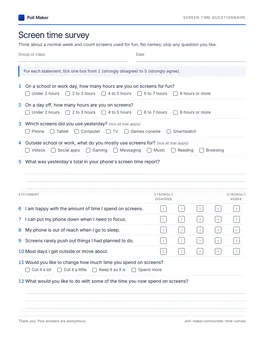
Screen time questionnaire
Every core question fits on the first sheet, followed by the school, work, evening, body, cutting back and background sets.
Download PDF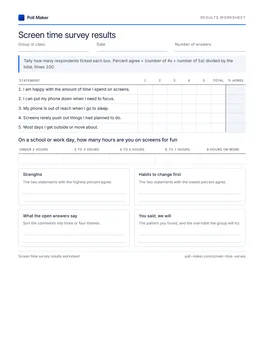
Group tally sheet
Count the hour bands, find the percent agreeing with each statement, and choose the habit the group will change first.
Download PDFRunning a screen time study for a school project
Screen time makes a favourite student research topic, and this questionnaire is ready for it. Three decisions make the project hold together.
Pick one comparison
| Research question | Compare |
|---|---|
| How accurate are screen time guesses? | Question 1 against the phone total in question 5 |
| Do late screens cut sleep? | When screens go off against hours of sleep |
| How does our school compare? | Share with 4 hours or more against the national 50.4%1 |
| Does feeling in control depend on hours? | The focus statement against the hour bands |
Survey whole classes
Choose whole classes and hand the survey to everyone in them; a link shared online pulls in the heaviest users. Keep it anonymous, say what the study is for, let people pass on any question, and check with the school before a student under 18 takes part.
Report bands, not a single average
Hour answers bunch up at the top and bottom, so show how many students fall in each band, then the share at 4 hours or more. Asked to name an established measure? Cite the adult screen time questionnaire by Vizcaino and colleagues2 for hours by device, or the Smartphone Addiction Scale short version6 for problem use, used as published. For the social media side of the same project, our student social media survey goes deeper on study and mood.
Screen time questions that go wrong, rewritten
Four common traps, each with a fix you can copy. For other topics, browse our survey question examples.
How much time do you spend on screens?
On a school or work day, how many hours are you on screens for fun?
The weak version leaves out which day and whether homework counts, so every person answers a different question.
Are you addicted to your phone?
I can put my phone down when I need to focus.
Few people accept a label. Asking about a specific moment of their day gets a straight answer.
Does screen time affect your sleep and your mood?
On a normal night, when do you stop using screens?
I wake up feeling rested on most days.
Two topics in one question, and it assumes an effect. Ask the habit and the outcome separately, then compare them.
Do you use screens too much? (Yes / No)
Would you like to change how much time you spend on screens?
Yes or no tells you nothing about direction. The better version separates people who want to cut back from people who are content.
Short answers on screen time surveys
Quick answers for teachers, student researchers and anyone running a wellbeing survey.
What questions should a screen time survey include?
Hours on a school or work day and on a day off, which devices, what the time is spent on, and a few statements about control and sleep. Ask for the phone's logged figure as well as the estimate, and end with one open question about what people would do with the time.
How do you measure screen time in a questionnaire?
Use hour bands, ask about work or school days and days off separately, and say whether screens for school or work count. Then ask people to read yesterday's total from their phone's screen time report, because estimates only moderately match logged use.3
How much screen time do teenagers have?
In a US national survey, 50.4% of teens aged 12 to 17 reported four hours or more a day, not counting schoolwork.1 The Canadian movement guidelines advise no more than two hours a day of recreational screen time for ages 5 to 17.5
Is there a validated screen time questionnaire?
Yes. Vizcaino and colleagues tested an 18-item adult questionnaire that asks hours by device for weekdays, weeknights and weekend days.2 For problem phone use, researchers often cite the 10-item Smartphone Addiction Scale short version.6 Everything in the bank here is newly written, free to edit and made for group surveys.
Can parents use this for younger children?
The wording is written for ages 13 and up. For a younger child, a parent can answer the core on the child's behalf: open it in the builder and change "you" to "your child". Skip question 5 unless the child has a phone of their own.
See where your group's screen hours go
Send the core 12 as a link people answer on the same phones you are asking about, or print the questionnaire for a class or a wellbeing session this week.