Retreat survey questions to send before, during and after the retreat
A retreat survey asks attendees at the moments that matter: before the retreat, to build the agenda around their questions; in the closing session, to judge whether it did its job; and six to ten weeks later, to check what stuck. Start with the 12-question closing evaluation, about four minutes to answer.
- 40questions
- 12in the closing core
- 6to send before
- 4 minto answer the core
By Michael Hodge, BSc Psychology Updated September 2026
All 40 retreat survey questions, by moment
Grouped by when you ask them: the closing-session core first, then before the retreat, the end of day one, the agenda, the venue, weeks later, and a set for boards and leadership teams. Every question shows the choices attendees get plus a note on what its result means for the organizer. The core 12 starts ticked; tick more, then open, print or copy your selection.
The closing-session core12 questions
Hand these out in the last session, before anyone packs up. Seven statements on whether the retreat did its job, three quick choices, then one thing to keep and one to change.
-
The retreat was worth the time away from my work.
Strongly disagree12345Strongly agree1 = Strongly disagree, 5 = Strongly agreeThe bottom line for attendees. A low score next to good session ratings usually means the retreat ran long or landed in a busy week.
-
I knew the purpose of the retreat before it started.
Strongly disagree12345Strongly agree1 = Strongly disagree, 5 = Strongly agreeTests the invitation and the pre-reading. When this scores low, the fix sits in the weeks before the next retreat, not in its program.
-
The retreat achieved the goals we were given for it.
Strongly disagree12345Strongly agree1 = Strongly disagree, 5 = Strongly agreeRead it next to the statement above. Clear goals that were missed point to the agenda; unclear goals turn this answer into a guess.
-
I know what we decided and who is doing what next.
Strongly disagree12345Strongly agree1 = Strongly disagree, 5 = Strongly agreeIf people leave unsure who owns each decision, nothing reminds them to act on it. A low score means the last session needs a written list of decisions, owners and dates.
-
I could say what I really thought, even when I disagreed.
Strongly disagree12345Strongly agree1 = Strongly disagree, 5 = Strongly agreeRetreats exist for the conversations a normal meeting cannot hold. A low score explains polite agreement in the room and grumbling in the car park.
-
I got to know colleagues I rarely work with.
Strongly disagree12345Strongly agree1 = Strongly disagree, 5 = Strongly agreeThe relationship payoff. Ten months after one staff retreat, 94% of the attendees who answered said it had helped them develop relationships with colleagues.1
-
I am leaving with an idea I will use in my work.
Strongly disagree12345Strongly agree1 = Strongly disagree, 5 = Strongly agreeAsks for one usable idea rather than general inspiration, so the follow-up can check later whether it was used.
-
Next time, the free time between sessions should be:
MoreAbout the sameLessBreaks, meals and free evenings are where much of a retreat happens. In one staff retreat evaluation, 53% asked for more of this time.1
-
If the next retreat were optional, would you come?
Yes, definitelyProbablyNot sureProbably notNoA plain test of value that attendance hides, because a staff retreat is rarely optional. Split it by length of service to see who the retreat works for.
-
Which part of the retreat was most valuable to you?
PlanningActivitiesLearningFree timeReflectionOne pick each, so the votes rank the parts of the retreat. Protect the winner in the next agenda before anything new is added.
-
What is one thing we should keep for the next retreat?
Open answerNames what to defend when the next budget or agenda gets squeezed.
-
What is one thing we should change for the next retreat?
Open answerOne change, not a wish list. Group the answers by theme (schedule, venue, a session, food) and fix the largest group first.
Before the retreat6 questions
Send these two to three weeks ahead, with the invitation, while sessions can still move and the venue can still be briefed.
-
What is the one question you most want this retreat to answer?
Open answerThe best agenda input there is. Read every answer before planning; a question that comes up again and again deserves its own session.
-
Which topics deserve the most time?
GoalsTeamworkRolesCustomersSkillsSuccessesTick all that applyEdit the list to your own topics first. Topics most people tick get the long sessions; topics a few tick can become breakouts.
-
What would make this retreat a success for you?
Clear decisionsA stronger teamNew skills or ideasTime to thinkSolving one problemShows whether people expect a planning retreat, a team retreat or a pause. If the votes split evenly, say plainly in the invitation which one this is.
-
How do you prefer to work through a hard topic?
Whole groupSmall groupsPairsThink alone, then discussTells the facilitator how to run each block. A strong vote for thinking alone first means building quiet writing time into the sessions.
-
Is there a topic you would rather raise here, anonymously, than out loud?
Open answerBrings sensitive issues to the organizer early, so they can be planned for instead of surfacing halfway through a session.
-
Do you have dietary, access or health needs we should plan for?
Open answerThe one item that may need a name to act on. Keep it optional and pass the answers straight to the venue.
End of day one3 questions
Three quick questions for the end of the first day, on screen as live polls or on a card by each seat. There is still a morning left to act on the answers.
-
How is the pace of the retreat so far?
Too slowAbout rightToo fastThe day-one number worth having. A split vote usually means some breakout groups are rushed while others wait, so check them before the morning.
-
What should tomorrow have more of?
Open discussionReal decisionsPresentationsFree timeGives the facilitator one lever to pull overnight, chosen by the room.
-
What should we fix before tomorrow morning?
Open answerCatches the small things, such as a cold room, a late lunch or a confusing handout, while they can still be fixed.
Sessions and the mix of time4 questions
Add these when the agenda itself is under review. The first two share the free-time question's answer scale, so all three can be read side by side.
-
Next time, the time in presenter-led sessions should be:
MoreAbout the sameLessIn the 2015 staff retreat evaluation cited below, no attendee asked for more expert-led sessions.1
-
Next time, the time for small-group and peer discussion should be:
MoreAbout the sameLessRead it with the question above. More peer time normally has to come out of presenter time or free time.
-
Every session clearly served the retreat goals.
Strongly disagree12345Strongly agree1 = Strongly disagree, 5 = Strongly agreeFinds the sessions that are on the agenda only because they always are. Pair a low score with the next question.
-
Which session should we shorten or drop, and why?
Open answerFrees time for what people asked for. The why tells you whether to cut the session or just run it better.
Venue, food and length4 questions
Add these when you are choosing where to go next year, or when complaints about rooms or meals show up in the open answers.
-
The venue suited the kind of work we came to do.
Strongly disagree12345Strongly agree1 = Strongly disagree, 5 = Strongly agreeA beautiful venue can still be wrong: no breakout rooms, poor sound, nowhere quiet. This asks about fit, not comfort.
-
The meeting rooms were comfortable all day.
Strongly disagree12345Strongly agree1 = Strongly disagree, 5 = Strongly agreeLight, air, seating and noise decide how the afternoon sessions go.
-
The food met my needs, including any dietary needs.
Strongly disagree12345Strongly agree1 = Strongly disagree, 5 = Strongly agreeIf a few people score this low, check whether their pre-retreat dietary answers ever reached the kitchen.
-
The length of the retreat was:
Too shortAbout rightToo longRead it next to the free-time question. Too long plus more free time means the schedule was overfull, not the retreat too long.
Leadership team and board retreats3 questions
For retreats where the people in the room make the decisions: a senior team, a board, a committee. Add these three to the closing survey.
-
We spent our time on decisions only we can make.
Strongly disagree12345Strongly agree1 = Strongly disagree, 5 = Strongly agreeBoard and leadership retreats drift into updates that could have been a memo. A low score says the agenda needs pruning.
-
I left clear on our top three priorities.
Strongly disagree12345Strongly agree1 = Strongly disagree, 5 = Strongly agreeIf members would name different priorities, the retreat did not settle them. Ask everyone to write their three down in the closing session and compare.
-
The balance between big-picture strategy and operational detail was:
Too much strategyAbout rightToo much detailThe standing tension of board retreats. This shows which way the room felt the agenda leaned.
Six to ten weeks later6 questions
Send this follow-up once normal work has resumed. It checks what the closing survey cannot: whether the decisions and commitments made at the retreat reached everyday work.
-
How many of the actions you agreed to at the retreat have you started?
AllMostSomeNone yetI took on noneThe follow-through number. None yet from people who did take on actions is a signal to reset dates, not to assign blame.
-
Retreat decisions now show up in our daily work.
Strongly disagree12345Strongly agree1 = Strongly disagree, 5 = Strongly agreeAsks about the team, not the person. A low score here next to a high one above means individual work is moving and shared priorities are not.
-
Leaders have followed up on what we agreed.
Strongly disagree12345Strongly agree1 = Strongly disagree, 5 = Strongly agreeWhen leaders go quiet after a retreat, attendees read it as the decisions not mattering. This makes the silence visible.
-
I have worked with a colleague I met at the retreat.
Strongly disagree12345Strongly agree1 = Strongly disagree, 5 = Strongly agreeThe relationship payoff, weeks on. Ten months after one staff retreat, most attendees described a stronger network of peers to call on at work.1
-
What has most slowed down the retreat actions?
Daily workloadUnclear ownersPriorities changedWaiting on othersNothing, on trackTurns a low follow-through score into something to fix. Workload and unclear owners need very different fixes.
-
What would help keep the retreat decisions moving?
Open answerIdeas from the people doing the work: a monthly check-in, a shared tracker, one owner per decision.
About you (optional)2 questions
Only for splitting results in a larger group. Skip both when the retreat was one small team, where any split could identify people.
-
How long have you worked here?
Under 1 year1 to 3 years4 to 9 years10 years or moreShows whether the retreat worked as well for newer staff as for long-serving staff, who may have come for different things.
-
Is this your first retreat with us?
YesNoFirst-timers notice what regulars stop seeing, from the joining instructions to the in-jokes.
With the invitation: the pre-retreat set
The pre-retreat survey in one click. Send it with the invitation, two to three weeks out, then plan the sessions around what comes back: the questions people want answered, the topics they rank highest and the needs the venue has to meet.
- 01What is the one question you most want this retreat to answer?
- 02Which topics deserve the most time?
- 03What would make this retreat a success for you?
- 04How do you prefer to work through a hard topic?
- 05Is there a topic you would rather raise here, anonymously, than out loud?
- 06Do you have dietary, access or health needs we should plan for?
When to send each set
A retreat survey is really four short surveys, each timed for the moment its answers can still change something.

| Moment | What to send | What the answers change |
|---|---|---|
| Two to three weeks before | Before the retreat: 6 questions, with the invitation | The agenda, the session formats and the venue brief |
| End of day one | End of day one: 3 questions, as live polls or cards | Tomorrow's pace, formats and small fixes |
| The closing session | The core 12, plus any add-on sets, in the last ten minutes | The verdict on this retreat and the brief for the next one |
| Six to ten weeks later | Six to ten weeks later: 6 questions | Which decisions to restart, and who needs support |
Keep the core wording identical from one retreat to the next, so this year's scores sit beside last year's. Send the follow-up only to the people who attended, and tell them in the closing session that it is coming. For staff surveys across the rest of the year, browse the employee survey questions hub.
Timing and follow-through beat clever wording
Good wording gets you only so far with a retreat. Timing and follow-through decide whether answers arrive at all, and whether anything changes because of them.
Attendees who wanted more of each kind of time next year
Ask about the mix of time, not only the sessions
Most retreat evaluations grade each session and skip the space between them. Worker and colleagues asked staff at the end of a three-day retreat whether future retreats should have more, about the same or less of three kinds of time. 53% wanted more unstructured time, meaning long breaks, meals and free evenings, and nobody asked for more expert-led sessions.1 Questions 8, 22 and 23 ask the same thing about your retreat in the same format, so the next agenda can follow the numbers.

End with commitments someone can check
Before people leave, ask each person to write one commitment as an if-then plan: when this situation comes up, I will do that. A meta-analysis of 94 tests found that plans spelling out when, where and how people will act helped people reach their goals, with an average effect of d = .65.3 Collect the cards, or a photo of them. The follow-up set can then ask about those exact commitments instead of a fading memory of the retreat.
Collect answers in the last session, not by email
People answer while they are still in the room together. When the 4-H staff retreats handed out their evaluation at the close of each retreat, 86% and 81% of attendees completed it.1 Show a QR code on screen, keep a pile of paper copies for those without phones, and give the survey ten minutes before the final goodbyes. Say that no one on the leadership team will see individual answers, and keep that promise.
Check back once the normal week returns
The closing survey captures the mood in the room; the follow-up shows what lasted. In a survey of training professionals from 150 organizations, 62% of employees were reported to apply new material right after training, 44% after six months and 34% after a year, and what happened back at work before and after the training was more strongly related to that transfer than what happened during it.2 Retreat decisions face the same pull of the ordinary week, which is what the six-to-ten-week set is for. Share its results at the next team meeting.
At the end of day one, project the pace question (number 19) as a live poll over the evening wrap-up. Each attendee votes from a phone, and by dinner you know whether tomorrow should speed up or slow down. Never projected a vote before? The walkthrough on making a live poll is worth ten minutes the night before.
Score the closing survey before you leave the venue
For each of the seven statements, enter how many attendees chose each point on the scale. The bars show what the retreat did well and flag the two statements that need attention before the next one. Print the page for whoever plans it.
- 1Key in the count of 1s through 5s for each statement; the percent agreeing updates as you type.
- 2The two shortest bars are where to begin. A low goals statement points to the invitation and pre-reading; a low decisions statement points to how the closing session was run.
- 3Read the keep and change answers next. They often name the cause of a low bar in the attendees' own words.
- 4Within a week, send a short note to everyone who came: what you heard, what the next retreat will do differently, and when the follow-up survey will arrive.
Retreat evaluation results
Which add-on sets fit your kind of retreat
Every retreat gets the core 12. What to add on top depends on what the retreat is for.
| Retreat purpose | Add these sets | The number to watch |
|---|---|---|
| Strategy or planning | Leadership team and board retreats; Six to ten weeks later | Question 4: who is doing what next |
| Team building | End of day one; Sessions and the mix of time | Question 6: getting to know colleagues |
| Learning or development | Sessions and the mix of time; Six to ten weeks later | Question 7: one idea to use at work |
| Board retreat | Leadership team and board retreats; Venue, food and length | Question 30: decisions only the board can make |
| Annual all-staff retreat | Venue, food and length; About you | Question 9: would people come if it were optional |
Many retreats mix purposes: a planning morning, a team afternoon. Pick the two sets that match the biggest blocks of time and keep the closing survey under about 20 questions, so the last session finishes on time. Planning a strategy retreat that needs views from people who will not be in the room? Collect them first with a strategic planning survey.
A stack of paper for venues with patchy signal
Retreat venues often have patchy signal, and a stack of paper on the tables gets answered. Print one questionnaire per attendee, collect them in a box by the door, and add up the paper answers on the tally sheet during the drive home.
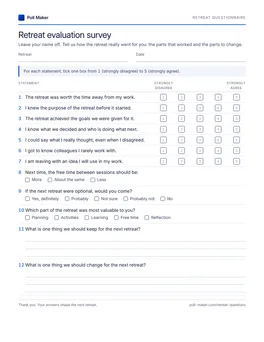
Retreat questionnaire
The closing-session core fills the first page. The other seven sets follow on three more pages, numbered on from 13, so the weeks-later page can wait in a folder until the follow-up.
Download PDF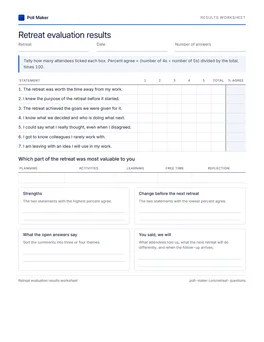
Retreat tally sheet
Add up the answers to the seven statements, convert each total to the share who agreed, count the votes for the most valuable part, and write down the first two changes.
Download PDFRetreat questions that miss, and what to ask instead
Weak retreat questions ask two things at once, or ask how people felt instead of what happened. More repairs like these, for every kind of question, sit in our survey question hub.
How satisfied were you with the retreat?
The retreat was worth the time away from my work.
The retreat achieved the goals we were given for it.
Satisfaction blends the food, the weather and the company into one number. The better pair asks whether it paid off and whether it did its job.
Were the venue and the food good?
The venue suited the kind of work we came to do.
The food met my needs, including any dietary needs.
Two questions in one. An attendee who loved the rooms and went hungry cannot answer it honestly.
Did you enjoy the team-building activities?
I got to know colleagues I rarely work with.
Enjoyment is not what team building is for. The better statement asks about the result the activities were meant to produce.
Will you apply what you learned at the retreat?
How many of the actions you agreed to at the retreat have you started?
Everyone says yes on the last afternoon. Asked weeks later about real actions, people give a real answer.
What organizers ask about retreat surveys
What questions should you ask after a retreat?
Ask whether it was worth the time, whether it met its goals, whether people know what was decided and who owns it, whether they could speak freely, and whether they got to know colleagues. Add one question on the mix of time and one on whether they would come back if it were optional, then close with a keep question and a change question. All of that fits in the 12 closing-session questions above.
What should a pre-retreat survey ask?
Keep it to about six questions: the one question each person wants answered, the topics that deserve the most time, what success would look like to them, how they like to work through hard topics, anything they would rather raise anonymously, and dietary or access needs. Send it two to three weeks ahead, early enough to rework the agenda around the replies.
When should you send a post-retreat survey?
In the closing session, before anyone leaves, while everyone is in one room and every session is still fresh. Then send the follow-up set six to ten weeks later to see what made it into everyday work.
Should a retreat survey be anonymous?
Yes, for the closing survey and the follow-up. Retreat groups are small, so drop the About you questions whenever a split would leave only a handful of people in a group, and ask a person from outside the leadership team to gather paper copies. The dietary and access question is the exception: make it optional, and let people add a name if they want the venue to plan for them.
Can I use these questions for a church or board retreat?
Yes. For a board, add the leadership team and board set. For a church or ministry retreat, change "my work" to "everyday life" in questions 1 and 7, swap Planning in question 10 for Worship, and keep the rest. To survey a whole congregation, use the church survey questions instead.
Plan the next retreat on real answers
Load the closing-session core into the builder for attendees to answer by phone, or bring printed copies to the final session.