What to ask local diners before your new restaurant opens
A survey before opening should test your concept on the people nearby: would they try it, what would they order, do the prices feel fair and how often would they come back. Start with the 12-question concept test, then add sets for the menu, pricing, hours, launch marketing and the soft opening.
- 39questions
- 12core questions
- 4 minto answer them
- 7optional sets
By Michael Hodge, BSc Psychology Updated September 2026
Concept, menu, price and hours: all 39 questions
The concept test starts selected. Tick another set for the decision in front of you, or single questions from anywhere. Each question carries its options and the reason it earns a place, ready to launch online, print for a clipboard or paste into another tool.
The concept test12 questions
Twelve questions for people who live or work near the site. Show them a short description of the restaurant and a sample menu with prices first; the six statements are their reaction to it.
-
Do you live or work near the planned location?
I live nearbyI work nearbyBothNeitherYour screen. Report the nearby answers on their own, because those people can become regulars.
-
How often do you eat out or order takeout?
Several times a weekAbout once a weekA few times a monthOnce a month or lessFrequent diners carry a new restaurant. Compare their reaction with everyone else before trusting an average.
-
When do you usually eat out?
BreakfastWeekday lunchWeekday dinnerWeekend brunchWeekend dinnerLate nightTick all that applySets opening hours and the first shifts you staff. A meal time nobody ticks can wait until after launch.
-
I would try this restaurant in its first month.
Strongly disagree12345Strongly agree1 = Strongly disagree, 5 = Strongly agreeThe trial question. Plan the first month on the strongly agree answers and treat plain agree as a warm audience for marketing.3
-
It offers something I cannot get nearby.
Strongly disagree12345Strongly agree1 = Strongly disagree, 5 = Strongly agreeTests the gap you think you are filling. High trial with a low score here points to curiosity rather than a reason to return.
-
The sample menu has dishes I would order.
Strongly disagree12345Strongly agree1 = Strongly disagree, 5 = Strongly agreeChecks the menu, not the idea. The Menu and drinks set then shows which dishes pull.
-
The prices on the sample menu feel fair.
Strongly disagree12345Strongly agree1 = Strongly disagree, 5 = Strongly agreeA quick read on price before the full price questions. Read it next to how often people say they would come.
-
The location would be easy for me to get to.
Strongly disagree12345Strongly agree1 = Strongly disagree, 5 = Strongly agreeSite fit. When nearby people disagree, parking, crossings or transit are the problem to solve before you sign.
-
I would bring friends or family here.
Strongly disagree12345Strongly agree1 = Strongly disagree, 5 = Strongly agreeThe social side of the concept. Groups fill tables and do your word of mouth for you.
-
If it opened, how often do you think you would eat there?
Every week2 or 3 times a monthOnce a monthA few times a yearProbably neverThe number behind a covers forecast. Multiply the weekly and monthly answers out, then plan on the lower end.
-
Would you mostly eat in, pick up or order delivery?
Eat inPick upDeliveryA mix of theseSplits the plan between seats, a pickup shelf and packaging, and shows whether delivery apps belong in the launch.
-
What would make this your regular place?
Open answerThe open answer that writes your opening message. The words locals use here belong on the sign and in your first posts.
Before you pick a concept4 questions
For the stage before you settle on a cuisine or sign a lease, when the question is what the area is missing rather than whether one idea works.
-
What kind of food is hard to find near here?
BrunchHealthy bowlsPizzaAsianMexicanBurgersVegetarianNothingTick all that applyThe gap question. Swap in the cuisines you are weighing, and keep "Nothing" so a crowded market shows up.
-
What matters most when you choose where to eat?
The foodPriceBeing closeSpeedThe atmosphereTells you which promise to lead with on the sign, the menu and the first posts.
-
What spoils a meal out around here?
Long waitsHigh pricesParkingNoiseEarly closingTick all that applyComplaints about the places people use now are openings for yours.
-
If a new place opened nearby, which would you use most?
Table serviceFast casualCafeBar with foodTakeoutSettles the format before the fit-out drawings, since an order counter, a bar and a full dining room are very different builds.
Room, hours and access4 questions
Use these when you are choosing between sites, or planning the layout and the schedule of the one you have.
-
How would you usually get here?
WalkBikeDrivePublic transportRideshareTells you whether parking, bike racks or a clear walking route matters most at this site.
-
How important is parking close to the door?
Not at all important12345Extremely important1 = Not at all important, 5 = Extremely importantRead it for drivers only. A high score can rule out a site with no spaces nearby.
-
Where would you most like to sit?
A boothA tableBar or counterOutsideNo preferenceGuides the floor plan and the mix of booths, loose tables, counter seats and patio.
-
How late should the kitchen stay open on weekends?
8 pm9 pm10 pm11 pmMidnight or laterA late close means a full extra shift. This shows whether nearby demand would pay for it.
Getting the word out4 questions
Questions that plan the opening marketing, and the one place in the survey to collect contact details from people who want in early.
-
How do you usually find out about a new restaurant near you?
FriendsSocial mediaGoogle MapsReview sitesWalking pastTick all that applyPuts the launch budget where locals actually look.
-
What would get you to try a new place in its first month?
An opening offerA free tastingA friend goingGood early reviewsAn opening menuNothing extraTick all that applyPicks the opening hook. "Nothing extra" is good news: those people come for the concept itself.
-
Would you like an invitation to the soft opening?
Yes, pleaseMaybeNo, thanksBuilds your preview guest list from people who already liked the idea.
-
If yes, what is the best email or phone number for your invitation?
Open answerKeep it optional and last, and use it only for the invitation you promised.
At the soft opening5 questions
Preview guests answer these at friends-and-family nights and trial services, when the menu and the flow can still change. They rate the meal they just ate.
-
How would you rate the food you had today?
Very poor12345Excellent1 = Very poor, 5 = ExcellentYour first real-plate score. Ask it once per course if you want it dish by dish.
-
How would you rate the service?
Very poor12345Excellent1 = Very poor, 5 = ExcellentFinds training gaps while the team is still practising on friendly tables.
-
How long did you wait for your food?
Too longA bit longAbout rightVery quickTells the kitchen whether ticket times are ready for a full room.
-
How likely are you to recommend this restaurant to a friend?
0123456789100 = Not at all likely, 10 = Extremely likelyA 0 to 10 recommend score you can keep tracking from the very first night.
-
What one thing should we fix before we open to everyone?
Open answerOne fix per guest. The repeats across tables become your launch-week list.
Pricing a main dish4 questions
The four van Westendorp price questions. Show one typical main dish with a description and no price, then ask all four in this order. Answers are amounts in dollars.
-
At what price would this dish be so cheap that you would doubt its quality?
Open answerThe floor. A price can be low enough to look like a warning sign, and this finds where that starts.4
-
At what price would it feel like a bargain?
Open answerWhere good value starts. Read it next to your food cost to see how much room you have.
-
At what price would it start to feel expensive, though you might still order it?
Open answerThe top of the comfortable range. A signature dish can sit near it.
-
At what price would it be too expensive to consider?
Open answerThe ceiling. Counted against the floor, it gives the price van Westendorp called optimal.4
About you (optional)2 questions
Useful when you want to compare age groups or party types. Wide bands keep small groups anonymous.
-
How old are you?
Under 2525 to 3435 to 5455 or olderUseful when the concept is aimed at one age group, such as students or young families.
-
Who do you usually eat out with?
On my ownA partnerFamily with kidsFriendsCoworkersSets the table mix: two-tops for couples, high chairs for families, long tables for groups of friends.
What each answer decides before opening day
Every question in the set feeds a decision you have to make anyway. Use this table to trim the survey to the decisions that are still open.
| Decision | Questions that answer it | What to look for |
|---|---|---|
| Go, change or wait | Try it in the first month, something new nearby, how often | Strongly agree on trial from nearby people, plus a solid group saying weekly or monthly |
| The menu | Dishes on a first visit, foods avoided, drinks | Dishes with few ticks come off before the menu goes to print |
| Prices | Prices feel fair, the four price questions | The range most locals accept for a main dish |
| Hours and staffing | Meal times, weekend closing time | The meal times most nearby people tick |
| Seats and packaging | Eat in, pick up or delivery; where to sit | The split between the dining room and takeout |
| Opening marketing | Where people hear about new places, first-month hook | The two channels and the one offer that come up most |
If a decision is already made, drop its questions. A shorter form gets finished by more of the people you most need to hear from.
The months before opening, step by step
Four habits give you numbers a restaurant can be planned around.

Ask the people who can walk in
The people who can drop in without planning a trip are the ones who can become regulars, so find respondents around the site. Stand outside at the meal times you plan to open, leave a QR card at nearby offices and gyms, and post the link in neighborhood groups. The first question screens for people who live or work nearby; report their answers on their own. As the SBA puts it, "Asking consumers yourself can give you a nuanced understanding of your specific target audience."1

Show a concept card, not a cuisine
Ask "would you like a Thai place?" and nearly everyone says yes. Show a one-paragraph description instead, with the name, a sample menu with real prices and a photo or two, then ask the concept test. Six of its statements point straight back to that card, so the answers describe your restaurant rather than a daydream.
Asking once is your first marketing
Measuring intentions changes them. In a study of purchase intentions, simply asking people once whether they planned to buy raised the rate at which they went on to buy, and the effect was smaller for products they already knew.2 A restaurant that has not opened yet is new to everyone. Ask once, close with the soft-opening invitation, and every finished survey is a local who has already pictured a meal with you.
Plan on the strongly agree answers
Research on new products has found substantial variation between what people say they will buy and what they do buy, which is why forecasters adjust stated intentions before using them.3 Build the first month on the people who strongly agree they would try it, treat plain agree as your marketing audience, and sketch weekly covers from the visit-frequency question.
Already have followers or a neighborhood group chat? Put one question in front of them with a free live poll; the format question makes a good opener. For story stickers, the Instagram poll question ideas page has more.
Reading the four price answers
The price set asks for amounts instead of ticks, so it needs one extra step. Here is the whole method with round numbers.
Van Westendorp's price sensitivity meter asks at what price a product feels too cheap, a bargain, expensive and too expensive. It suits the very early stage when a business does not yet know which price range it is playing in,4 which describes most restaurants before opening.
Count who turns down each price
List the main-dish prices you are weighing. At each one, count the people whose too-cheap answer is at or above it, because they would doubt the quality, and the people whose too-expensive answer is at or below it, because they would not order.
| Main dish price | Too cheap to trust (of 100) | Too expensive (of 100) |
|---|---|---|
| $12 | 41 | 2 |
| $14 | 27 | 6 |
| $16 | 15 | 11 |
| $18 | 8 | 19 |
| $20 | 4 | 33 |
| $22 | 2 | 52 |
Find where the counts cross
In this example the two counts cross between $16 and $18. Van Westendorp called that crossing the optimal price point. Two more crossings, one built from the bargain answers and one from the expensive answers, mark the low and high edges of the range most people accept.4 Set most mains inside that range and let one or two signature dishes sit near the top of it.
A spreadsheet does the counting: one column per question, one row per person, and a COUNTIF for each price you are weighing.
Score the concept statement by statement
For each of the six concept statements, key in the number of people behind every box. You then see which part of the idea wins locals over and which part needs work, on one printable page for partners or the bank.
- 1Enter the answers from people who live or work nearby first. Run a second report for everyone else if you want the comparison.
- 2The chart counts the 4s and 5s as agreement. Compare the six statements with each other: the lowest one is the part of the concept to rework.
- 3A strong trial score next to a weak score for something new means people will visit once. Give them a reason to come back before launch.
- 4Pin the best open answers under the chart. They are the words for your sign, your menu and your first posts.
Concept test results
A minute on the sidewalk: the short version
Stopping people outside the site gives you about a minute each. These five cover how often they eat out, whether they would try the place, price, how often they would come and what would make it theirs.
- 01How often do you eat out or order takeout?
- 02I would try this restaurant in its first month.
- 03The prices on the sample menu feel fair.
- 04If it opened, how often do you think you would eat there?
- 05What would make this your regular place?
Take it to the street on paper
Paper works where your future customers already are: the sidewalk outside the site, a farmers market stall, the lobby of the office block next door. Print as many as you need; the layout suits letter and A4 alike.
Heading to a farmers market stall?
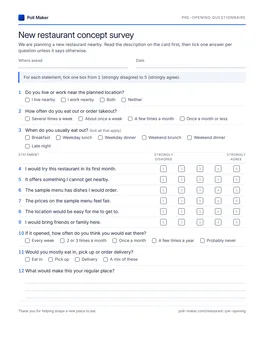
Pre-opening questionnaire
The concept test fills the first sheet, with room at the top to clip your concept card. The seven optional sets run on from page two.
Download PDF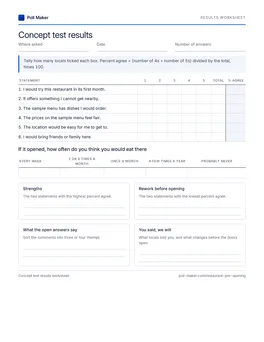
Concept results worksheet
Tally the six concept statements, turn each into a percent agree, and count the visit-frequency answers as the base for a weekly covers estimate.
Download PDFUsing it for a business plan or feasibility study
Lenders, landlords and business-school markers all look for the same thing in a market section: evidence that local people want this restaurant. Survey answers are that evidence.
US food spending in 2025, trillions of dollars
The SBA's market research checklist covers demand, market size, location, competition and pricing,1 and this set has questions for each. Open the section with the national picture: US spending on food away from home reached $1.41 trillion in 2025, more than the $1.10 trillion spent on food at home.6 Then narrow it to your street with your own numbers.
How many people to ask
Aim for 150 to 200 completed surveys from people who live or work nearby. Pew Research puts the margin of error for about 160 answers at roughly 8 points either way, and at 3 points for around 1,067.5 That is plenty to compare the six concept statements; splitting results into groups takes more.
What to put in the write-up
State how many people answered and where you found them, the share of nearby people who strongly agree they would try it, the expected visit frequency, the price range from the four price questions and a few lines quoted from the open answers. Attach the printed questionnaire as an appendix.
Pre-opening questions that invite a polite yes
Each weak version below earns a polite yes that tells you nothing. Our survey question guide has fixes like these for every question type.
Would you eat at a new Italian restaurant in this area?
I would try this restaurant in its first month. (asked after the concept card)
Almost anyone says yes to a vague idea. A real name, menu and prices get a real reaction.
Wouldn't it be great to have a farm-to-table spot nearby?
It offers something I cannot get nearby.
The weak version tells people which answer you want. The statement leaves room to disagree.
Would you pay $24 for our signature pasta?
At what price would it start to feel expensive, though you might still order it?
One price invites a quick yes. The open price questions show where the range really sits.
Is the location convenient and is parking easy?
The location would be easy for me to get to.
How important is parking close to the door?
Two questions in one. A walker who finds it close and a driver who finds no parking give the same muddled answer.
Questions owners ask before opening day
Short answers for owners, chefs and students writing up a restaurant plan.
What questions should you ask before opening a restaurant?
Start with a concept test for people nearby: whether they would try it, whether it offers something new, what they would order, whether the prices feel fair, how easy it is to reach and how often they would come. Then add meal times, eat in versus takeout, the price range for a main dish and how they hear about new places.
How many people should you survey before opening a restaurant?
Aim for 150 to 200 completed surveys from people who live or work nearby. At about 160 answers the margin of error is roughly 8 points either way,5 which is enough to compare the concept statements and plan a first month.
When should you run a pre-opening survey?
In up to three rounds: the concept questions before you commit to a cuisine or a lease, the concept test with the menu and price sets once a draft menu exists, and the soft-opening set during preview services. Each round answers the questions still open at that point.
How do you get people to answer a survey for a restaurant that does not exist yet?
Go where they already are: the sidewalk outside the site at lunch and dinner, nearby offices, school gates and neighborhood groups online. A small card with a QR code gets you the online answers, and the soft-opening invitation at the end gives people a reason to finish.
Can I keep using these questions after the restaurant opens?
The soft-opening set works for the first weeks of service. For feedback after every visit once you are open, SuperSurvey has a post-visit guest survey built for that job.
Test the concept before the doors open
Load the concept test, choose the extra sets you want, and get the link around the neighborhood this week, or print copies for a clipboard.